

5–6 October 2026 | Prague, Czech Republic
What does it take to move reproducibility from an ambition to an everyday reality of research?
As the OSIRIS project approaches the end of its funded journey, this question took centre stage in Prague, where researchers, funders, publishers, institutional representatives, reproducibility networks and other stakeholders came together for “The Legacy of OSIRIS: Open Science for Reproducible Research”, the project’s Final Symposium held on 5–6 October 2026.
The two-day symposium was both a moment of reflection and a call to action.
After four years of research, collaboration, experimentation and dialogue, OSIRIS brought its work together in one place: evidence on the drivers and barriers affecting reproducibility, interventions designed for different parts of the research ecosystem, practical tools and guidance, training resources, policy work, communication approaches and lessons learned along the way.
But the symposium was deliberately not designed simply to showcase what had been achieved.
Its central question was what happens next?
How can OSIRIS results be used in real research environments? What prevents good practices from being implemented? Who needs to take responsibility? What resources are required? And how can tools, training and recommendations developed through a European research project remain relevant and useful after the project itself comes to an end?
Across presentations, discussions, workshops and a stakeholder panel, one message emerged particularly strongly:
Reproducibility is a shared responsibility! It cannot be placed solely on individual researchers. Institutions, funders, journals and publishers, infrastructure providers, ethics bodies, research leaders, communities and other actors all influence the conditions in which research is conducted, and lasting progress depends on these actors working together.
Looking back: what has OSIRIS learned?
The symposium opened with OSIRIS Coordinator Inge Stegeman, who reflected on the project’s origins, its initial ambitions, and the journey that brought the consortium to its final stage. The opening set the tone for the first day: taking stock not only of what OSIRIS produced, but of what the years of research and experimentation had revealed about the complexities of reproducibility.
From policy ambitions to research reality
Veerle Van den Eynden and Magdalena Kozula presented OSIRIS work examining the drivers, barriers and facilitators of reproducible research, including the relationship between formal policies and what actually happens in everyday research practice.
One important message was that policies cannot create meaningful change through ambition alone. Their effectiveness depends on whether


they reflect how research is genuinely conducted and whether implementation is considered alongside formal commitments.

Building on this theme, Nicholas DeVito presented work auditing policies supporting reproducibility, including an examination of TOP2025 criteria among EU-relevant stakeholders. The work highlighted varying levels of engagement with reproducibility practices, the importance of how policies are formulated, and the potential gap between endorsing reproducibility-related principles and putting them into practice.
A representative of the European Research Executive Agency (REA) also shared remarks on behalf of the European Commission, highlighting the importance of Open Science practices in supporting higher-quality, more trustworthy research.
Testing what works
A major part of OSIRIS has been not simply advocating for reproducibility but investigating interventions that could help improve it.
Florian Naudet presented work examining interventions intended to support researchers and institutions in adopting more reproducible research practices. The breadth of approaches developed within OSIRIS was perhaps best illustrated by one particularly memorable example: a creative randomised controlled trial involving Christmas tree meringues, used to explore whether reporting guidelines could improve reproducibility.
Behind the playful experiment was a serious question. If research practices are to change, interventions themselves need to be tested.
The example demonstrated how reproducibility research can use experimental, and sometimes unexpected, approaches to investigate practical questions around reporting, replication and research quality.
The focus then widened from researchers to other powerful actors within the system.


Ayu Putu Madri Dewi presented OSIRIS work on interventions involving research funders and publishers, including reproducibility checklists and other approaches to support improved research practice.
Several findings from this strand of work were still unpublished at the time of the symposium, meaning that the full story is not yet complete. Further OSIRIS studies and results are therefore still to come as research from the project continues to be published.
Building evidence-based training and guidance
Changing systems also means ensuring that people have access to practical knowledge and support.
Birgit van Dijk presented OSIRIS work on evidence-based reproducibility training and stakeholder guidance. Among the outputs highlighted was a reproducibility training course whose effectiveness has been tested and which is being developed towards a final online MOOC format, accompanied by a discussion forum and toolkit. The work reflects a broader OSIRIS principle: training and guidance should themselves be informed by evidence and should respond to the different needs of the people expected to use them.

This question of learning also extended inward.

Inge Stegeman presented work on the OSIRIS reproducibility audit, designed to help monitor reproducibility across project activities, identify opportunities for improvement and support transparency and shared learning. Importantly, the discussion framed auditing not as a mechanism for punishment but as a way to understand current practice and create opportunities to improve over time.
Communication as part of impact
Reproducibility cannot create change if evidence, tools and recommendations remain difficult to find or understand.
Presenting OSIRIS work on communication, dissemination and impact, WP6 lead Hynek Roubík reflected on efforts to build a broader communication ecosystem around project outputs.
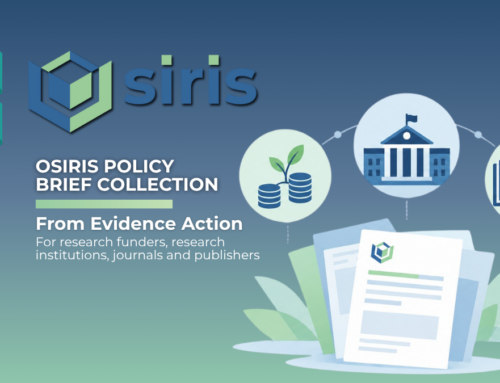
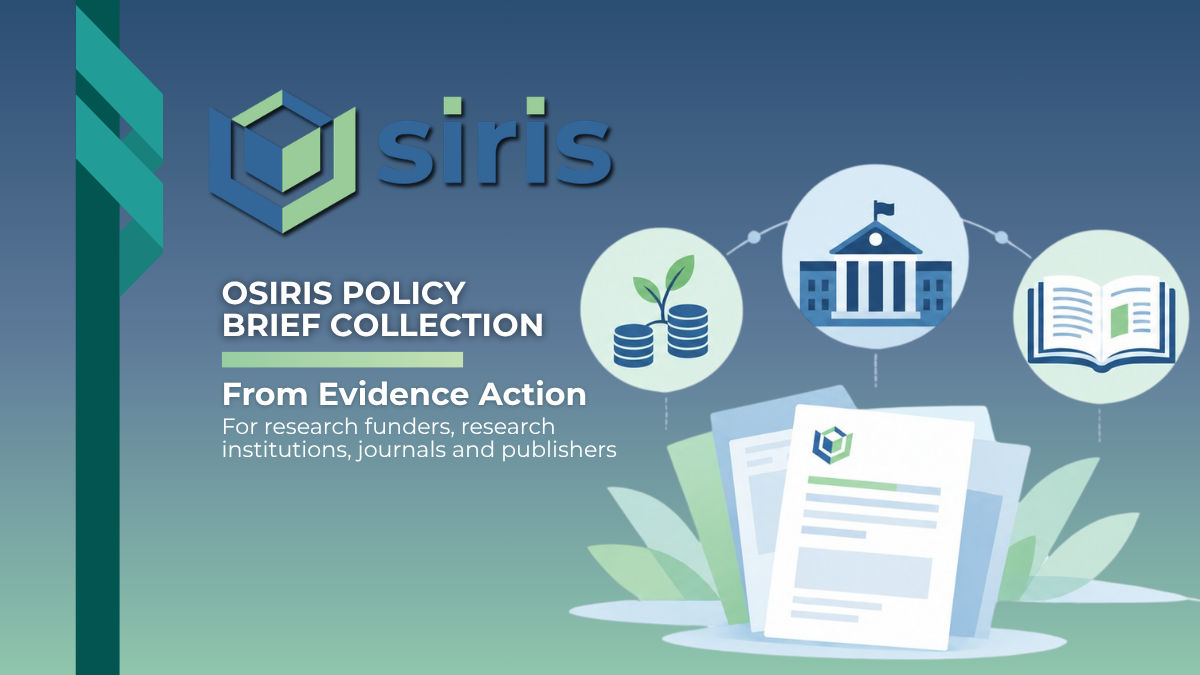
One example was the transformation of existing OSIRIS policy briefs into more accessible and visual summaries, helping complex findings and recommendations reach audiences beyond those likely to read a full technical document.
The underlying message was clear: communication should not be treated as something added at the end of research. It is part of the process through which evidence becomes visible, understandable and potentially usable.


This idea was also reflected in the “10 Tales of Reproducibility”, presented by Veerle Van den Eynden. Using real experiences and storytelling to explore challenges and lessons connected with reproducible research, the Tales later became an important reference point during discussions about how OSIRIS can communicate beyond its immediate research community.
By the end of Day 1, the breadth of the project could be seen as a whole: policies, interventions, audits, training, communication, guidance, and practical tools.
The question for Day 2 was therefore different.
How can all of this move from project outputs to action?
DAY 2: PUTTING REPRODUCIBILITY INTO PRACTICE


On the second day, we shifted the focus from presentation to participation.
Stakeholders participated in an interactive World Café-style workshop, rotating among five discussion areas linked to key OSIRIS outputs. Researchers, funders, publishers, institutional representatives and others involved in Open Science and reproducibility were asked not simply whether OSIRIS outputs were valuable, but how they could work in real environments. The participants tested tools and recommendations against stakeholder needs, identified barriers to implementation and generated ideas for how OSIRIS work could continue beyond the project.
Across the tables, the principle of shared responsibility became increasingly important.
Reproducibility, participants emphasised, should not become an exercise in assigning blame. Different actors have different responsibilities, resources and forms of influence; each should take their responsibility. Progress therefore requires clarity about roles — and cooperation between them.
Policies need owners, resources and routes to implementation
Discussions around model policies and guidelines examined how institutions, funders, journals and other stakeholders can translate general commitments into actionable expectations. Participants highlighted the influence of funders, who can shape expectations at an early stage through the conditions attached to research funding.
At the same time, the conversation demonstrated that the ecosystem extends beyond the actors that most often participate in Open Science practices. Ethics committees, for example, were raised as another potentially important stakeholder.
Several practical messages emerged.
- Actions need clear ownership.
- Guidelines need to be actionable rather than aspirational.
- Communication needs to be adapted to specific audiences rather than relying on “Open Science” as a broad umbrella.
- And implementation requires resources, including staff time and, in some cases, dedicated roles responsible for supporting these activities.
Participants also stressed the need to understand whether policies are implemented rather than simply adopted on paper.
A checklist should support research — not become another box to tick
Another group examined how the OSIRIS reproducibility checklist could be used by researchers, funders, editors and others. Potential applications ranged from supporting research proposals and monitoring practice to serving as a quality-improvement intervention. But the discussion also produced an important warning: implementation should not become overly rigid or dogmatic.
Research takes place across different disciplines, environments and methodological traditions. A checklist therefore needs enough flexibility to be useful in different contexts. One of the clearest recommendations was to embed tools within workflows that already exist.
The more a reproducibility tool becomes part of processes that researchers, institutions or funders already follow, the more realistic its long-term uptake becomes.
Funders and publishers can help change the conditions of research
Discussions around interventions for funders and journals highlighted the structural influence these actors can have. Funders control resources and can establish expectations or requirements. Publishers and journals influence reporting and publication practices.
But creating expectations is only part of the challenge.
Monitoring whether commitments are actually fulfilled also requires time, staff and resources, raising a wider question that repeatedly surfaced during the symposium: who is responsible for making implementation possible?
Participants also considered how evidence can be translated into compelling cases for change within organisations, including the role that examples and narratives may play in helping funders and publishers understand the value of reproducibility interventions.
Training must reach beyond the already convinced
Discussions on reproducibility training focused not only on the content being developed by OSIRIS, but on a particularly difficult dissemination challenge:
How do we reach people who are not already part of the Open Science and reproducibility community?
Existing reproducibility networks provide an obvious route. But participants also considered other pathways, including libraries, integration with PhD education, and possible connections between training and funding requirements.
The discussion also challenged the idea that training should primarily target early-career researchers. Senior researchers and supervisors were identified as equally important audiences because of their influence on research cultures, expectations and the practices passed from one generation of researchers to another.
Communicate less — but communicate it better!
The fifth discussion turned to communication, dissemination and the sustainability of OSIRIS outputs.
One recommendation stood out in its simplicity: Fewer, clearer messages may achieve more than trying to communicate everything at once.
Participants discussed how OSIRIS can make its most important findings easy to find, access and use, including after the formal project ends. Storytelling again emerged as an important tool, with the 10 Tales of Reproducibility highlighted as an example of how human experiences can make complex research-practice questions more relatable.
Participants also considered whether communication should extend beyond the scientific community, including stronger engagement with the media and existing professional and institutional networks.
The goal is not merely to keep OSIRIS outputs online. It is to keep them alive, discoverable and useful.
MAKING REPRODUCIBILITY WORK IN PRACTICE


The stakeholder discussions fed directly into the afternoon panel, appropriately titled “Making Reproducibility Work in Practice.”
The panel brought together:
- Frank Miedema, UMC Utrecht
- Sarah McCann, Charité – Universitätsmedizin Berlin / iRISE
- Martin de Kort, EATRIS ERIC
- Anastasiia Marmyleva, University of Helsinki / ReproducibiliTea
- Henk Kummeling, CoARA / Utrecht University
Rather than looking for one universal solution, the conversation repeatedly returned to context. Different disciplines, institutions and research cultures operate under different norms, incentives, resources and constraints.
Henk Kummeling stressed the importance of context, interdisciplinary collaboration and conversation, while also emphasising the need for action plans capable of turning commitments into implementation. Leadership matters, but so does recognising and rewarding those already doing the work of advancing reproducibility.
For Anastasiia Marmyleva, one barrier is simply knowing where to begin. Communities such as ReproducibiliTea, combined with small and manageable first steps, can make reproducibility feel more accessible.
Sarah McCann similarly highlighted the need to meet researchers and institutions where they are. Different research cultures require different approaches, making co-development particularly important.
Martin de Kort stressed the value of showing what reproducibility actually looks like in practice. Tools are more likely to be understood and accepted when people can see how they function in real settings. Leadership, he noted, can also mean leading by example.
And Frank Miedema widened the conversation beyond the research system itself, highlighting public engagement and, using patients as an example, the importance of involving people from the beginning of research and keeping them informed throughout the process.
Taken together, the panel echoed one of the central lessons of the symposium:
There is no single intervention that can “solve” the challenges with reproducibility. What matters is building conditions in which better practice becomes possible, supported and valued.
FROM PROJECT RESULTS TO AN OSIRIS LEGACY
Across both days, several themes returned again and again.
- Reproducibility must be a shared responsibility. Researchers cannot carry the burden alone. Funders, institutions, publishers, infrastructure providers, ethics bodies, research leadership and wider communities all shape research environments.
- Principles must become practice. Supporting Open Science in principle is not enough. Policies, recommendations and commitments need mechanisms for implementation.
- Context matters. Tools and guidance must be sufficiently flexible to work across different disciplines, institutions and research cultures.
- Resources matter. Monitoring, training, implementation and support require people, time and funding. Reproducibility cannot depend indefinitely on individual goodwill.
- Embed rather than add on. Checklists, training and other tools are more likely to become part of research culture when integrated into existing processes rather than introduced as additional tasks.
- Leadership and incentives matter. Institutional commitment, recognition and reward structures can influence whether good practices become normal practice.
- Communication matters. Evidence needs to be findable, understandable and tailored to the people expected to act on it.
And finally:
- Sustainability matters. Because a project ending does not mean its questions have been answered.
THE SYMPOSIUM ENDS. THE WORK DOES NOT!

On 7 October, following the two-day public symposium, the OSIRIS consortium met internally for a final reflection on what had been heard in Prague and what it means for the remaining phase of the project. The consortium reviewed the work still ahead, including remaining deliverables and reporting, while also looking further forward: implementation, impact, sustainability, future collaboration and the long-term legacy of OSIRIS.
The discussion reflected an important shift. The question is no longer simply what OSIRIS can or has produced. It is how its tools, evidence, publications, training, policy work and lessons can continue to support the research community once the funded project has formally ended.
That may ultimately be one of the most important legacies of the Prague symposium! OSIRIS began with questions about reproducibility. Its final symposium demonstrated that improving reproducibility is not about finding one answer, producing one checklist or writing one policy.
It is about building a research ecosystem in which better practices are possible, expectations are clear, responsibility is shared, evidence informs action, and researchers have the structures and support they need to do their work transparently and reproducibly.
The Final Symposium therefore did not mark an endpoint.
It marked the transition from OSIRIS as a project to OSIRIS as a body of evidence, tools, knowledge and experience that can continue to shape how reproducible research is understood and put into practice.
The project may be approaching its formal conclusion. Its legacy is only beginning!
OSIRIS – Creating Trust in Open Science & Reproducibility through Accessibility and Transparency.







Keep In Touch