
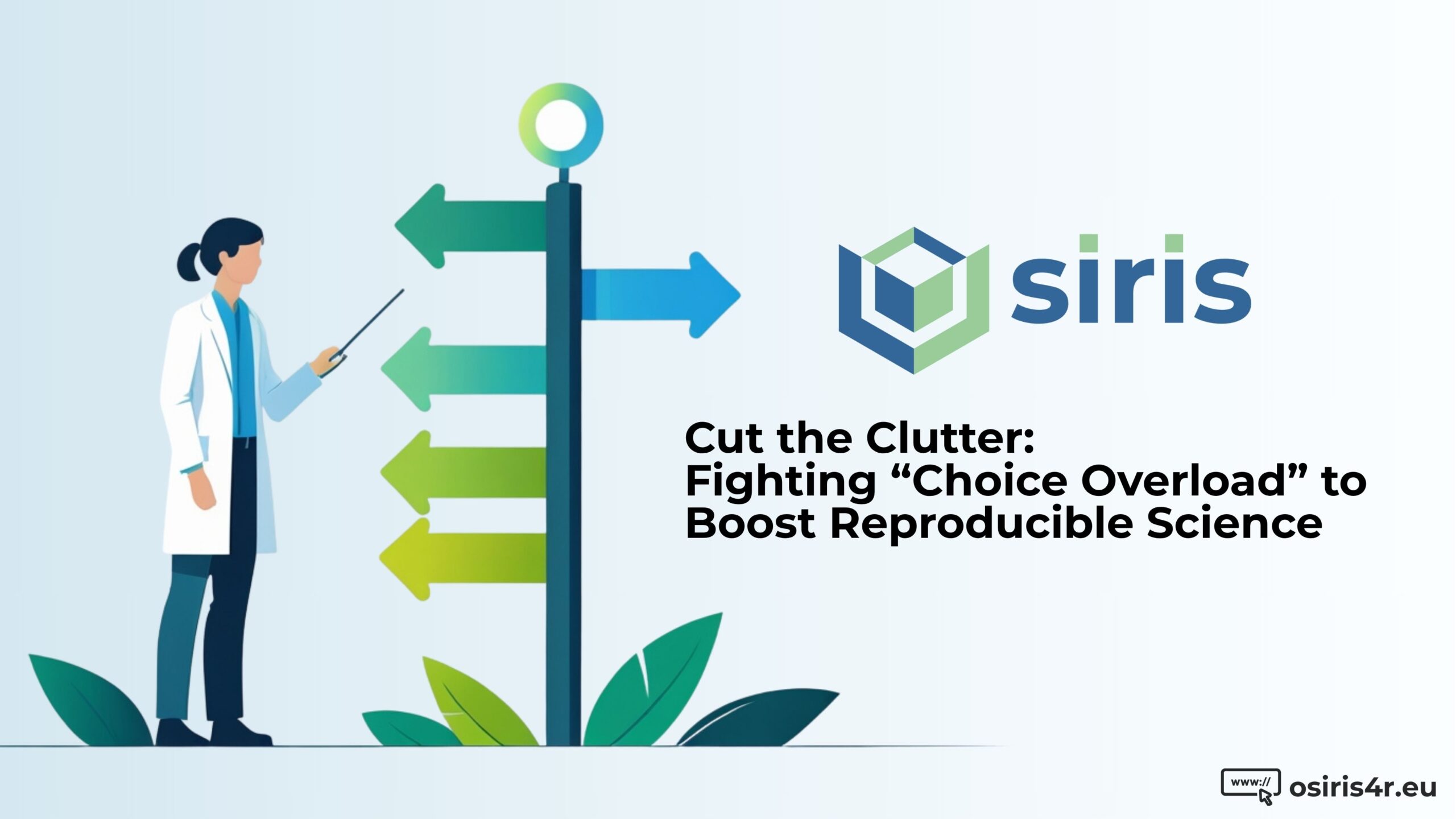
What if reproducibility improves when we deliberately limit our options? What if the open-science push stalls not from resistance, but from too many ways to start?
While browsing the news, a Dutch management expert caught my eye [1]. He often writes about personal leadership grounded in research. This time, he cited two German psychologists who argue that “choice overload” can paralyse pro-environmental action: when there’s too much you could do, you don’t begin at all [2]. Another study backs this up: people given 20 options act less than those offered just 1, 5, or 10 [3].
Now translate that to open science and reproducibility. Want to share data? You face GitHub, DANS, Zenodo, OSF, your personal site, publisher repositories, and multiple metadata schemes on top. Want to improve reproducibility more broadly? Our scoping review maps over 40 interventions, data sharing, data-sharing policies, data-availability statements, reporting guidelines and their endorsement, workflow tools, preregistration, and more [4]. For none is there compelling evidence that they consistently “work,” which can make picking one even harder.
So, what helps? The management expert proposes mental contrasting:
- Shortlist two options you actually like.
- List the obstacles for each.
- Design an “if–then” plan to automate your next move.
Examples:
- IF I work on an EU-funded project, THEN I deposit datasets in Zenodo.
- IF I’m peer-reviewing, THEN I recommend the appropriate reporting guideline in my review.
- IF a study includes code, THEN I require a public repository with a README before acceptance.
Small constraints reduce friction. Fewer, clearer paths make action more likely.
Have a go, and tell us your implementation strategy. Which two options will you commit to, and what’s your if–then?
References
- Ben Tiggelaar in NRC: Als we heel veel goede adviezen krijgen, komen we juist niet in actie – NRC
- Oettingen and Gollwitzer: Individualizing proenvironmental behavior in the context of structural impediments.
- Andrews and colleagues: Too many ways to help: How to promote climate change mitigation behaviors – ScienceDirect
- Open science interventions to improve reproducibility and replicability of research: a scoping review | Royal Society Open Science
Editor’s note: On the OSIRIS blog, we use numbered references for clarity. In the reference list, each item is linked directly to its source (NRC article, journal page, or DOI).












Keep In Touch