
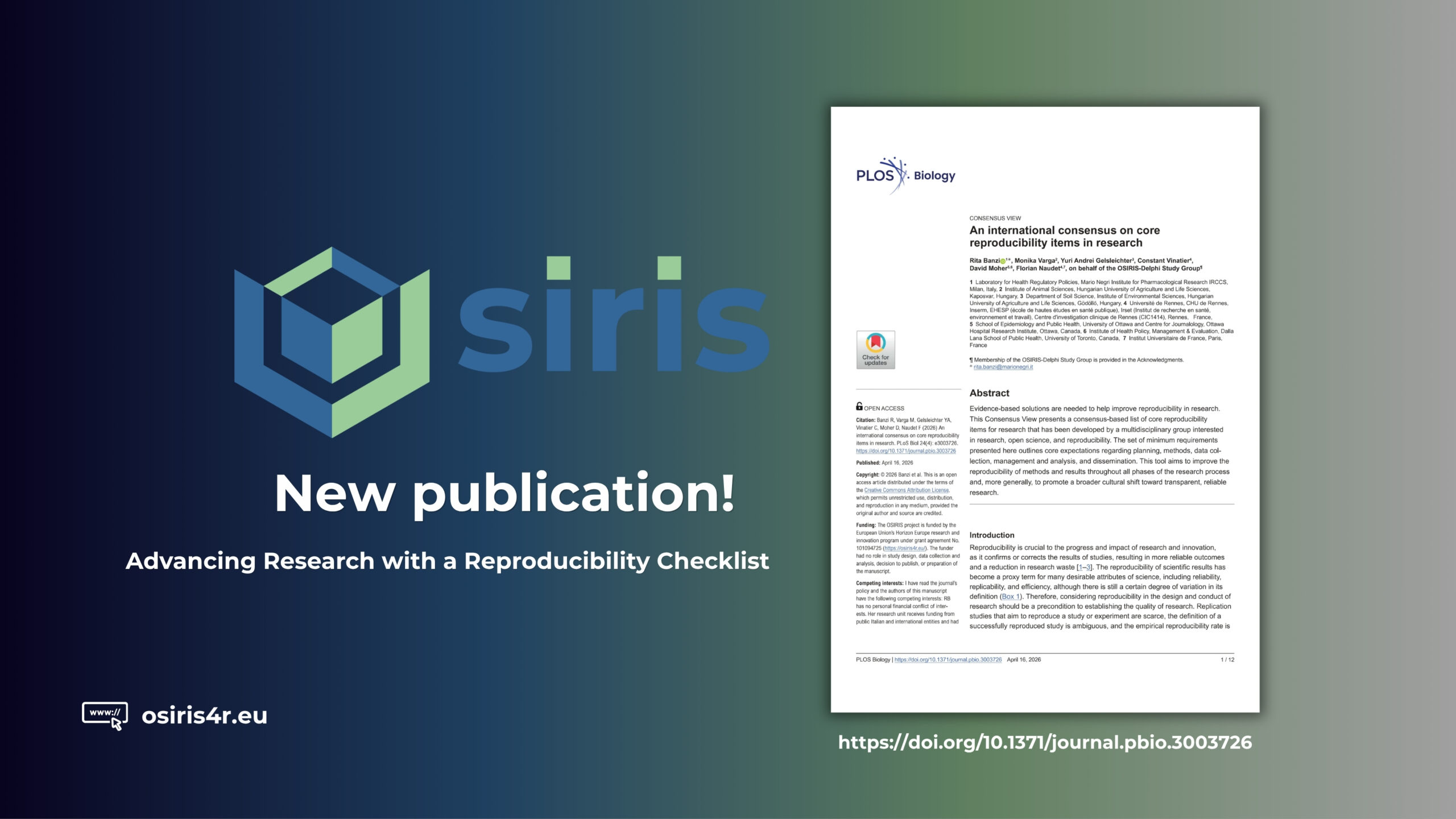
The OSIRIS project is pleased to highlight a recent publication in PLOS Biology that contributes to international efforts to strengthen research transparency and reproducibility. The article introduces a consensus-based reproducibility checklist, developed through expert collaboration, including contributions from OSIRIS team members Rita Banzi, a specialist in Clinical Pharmacology and Pharmaceutical Sciences at the Mario Negri Institute in Milan, Monika Varga, Senior Researcher at the Hungarian University of Agriculture and Life Sciences, MATE, Yuri Andrei Gelsleichter, Constant Vinatier, a researcher at LORIER, David Moher, and Florian Naudet, Professor at the Université de Rennes and co-director of LORIER, providing a structured and practical framework to improve research quality across disciplines.
Addressing a Core Challenge in Modern Science
Reproducibility remains a fundamental pillar of credible research, yet it is inconsistently implemented across scientific fields. Variability in study design, reporting standards, and data management practices continues to limit the validation and reuse of scientific findings.
This publication addresses these challenges by defining a unified set of core elements that support reproducible research. The proposed checklist promotes a systematic approach that integrates reproducibility considerations throughout the research lifecycle from study design to data handling, analysis, and publication.
Importantly, the work contributes to ongoing international discussions on how to move beyond high-level open science commitments toward practical, standardised implementation. By providing a common reference framework, it supports greater comparability, accountability, and long-term usability of research outputs.
From Principles to Practice
A key strength of this work lies in its practical orientation. Moving beyond general recommendations, the checklist provides a clear and adaptable tool applicable across diverse research contexts.
It supports:
- Clearer and more transparent documentation of research processes.
- Improved alignment between researchers, reviewers, and funders.
- More consistent evaluation of research quality.
By offering a shared reference framework, it helps reduce fragmentation in research practices and enhances the reliability of scientific outputs.
Relevance for Open Science and OSIRIS
The publication aligns closely with the objectives of the OSIRIS project, which promotes the integration of open science principles into everyday research workflows. By translating these principles into a concrete and usable checklist, the study contributes to strengthening research integrity, transparency, and usability in practice.
In this context, the checklist represents not only a methodological contribution but also a step toward embedding reproducibility as a standard expectation, rather than an optional add-on in the research process.
Read the Full Article
To explore the full publication and its methodology in detail, visit: https://journals.plos.org/plosbiology/article?id=10.1371/journal.pbio.3003726
Stay tuned for updates on other OSIRIS activities! Visit our website to read our blogs and events section and follow us on social media to discover what’s new and how you can get involved!
OSIRIS “Creating Trust in Open Science & Reproducibility through Accessibility and Transparency!”









Keep In Touch